The talk will focus on the role animals have played in the history of opera, from Orpheus charming wild beasts to the singing Jack Russell in Philippe Manoury’s latest opera, including Rameau’s frogs, Offenbach’s bulldog, Casella’s snake woman, Henze’s singing cats, Braunfels’ degenerate birds, and Leininger’s dinosaurs.
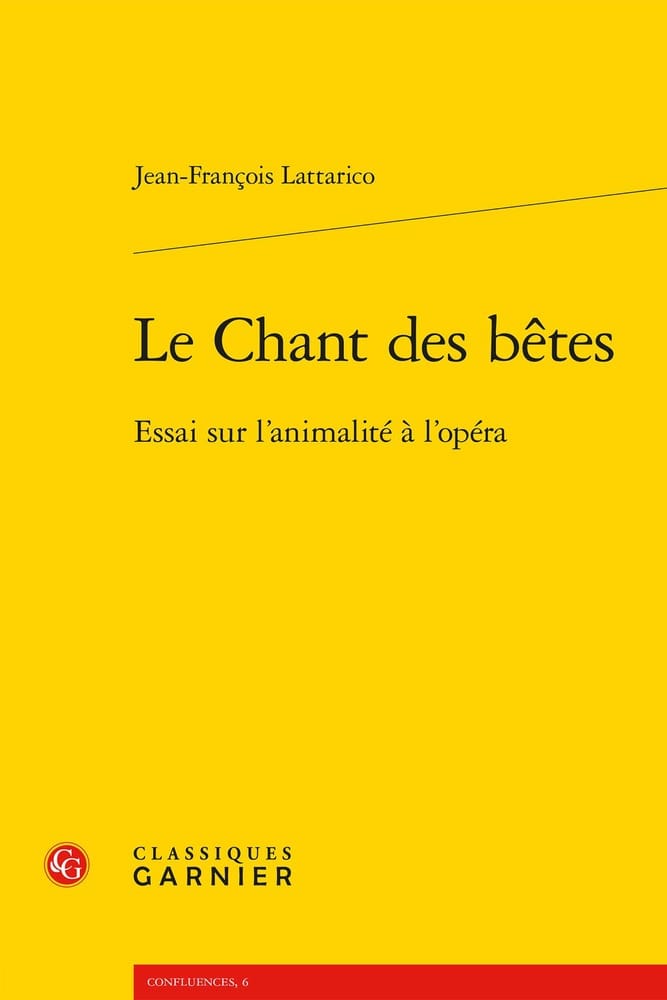
From a mere dramatic foil to a parodic element, animals have become full-fledged characters in the 20th and 21st centuries: this book, *Le chant des bêtes*, demonstrates for the first time, in the most comprehensive way possible, that the history of opera is entirely punctuated by animals of all kinds (and feathers). It also explores the animal nature of humans, and, as a counterpoint, the humanity of animals, both united in a single sensory reality, of which music is perhaps the common matrix.
Born in Paris (1968). A graduate of the École Normale Supérieure (ENS), he is a professor of Italian literature and civilization at the University of Lyon 3 Jean Moulin. He specializes in 17th- and 18th-century literature, rhetoric, and opera. He has translated Ariosto’s *La Lena* (Paris: Allia, 1999), La Messaline by Francesco Pona (Saint-Étienne, PUSE, 2009), and published *Venise incognita. Essai sur l’académie libertine au XVIIe siècle* (Paris, Honoré Champion, 2012), *Busenello. Un théâtre de la rhétorique* (Paris, Classiques Garnier, 2013), as well as the latter’s edition of his librettos, Delle ore ociose/Les fruits de l’oisiveté (Paris, Classiques Garnier, 2016), and by the same author the unpublished libretto Il viaggio d’Enea all’inferno (Lecce, Argo, 2021); a book on animals in opera (Le chant des bêtes. Essai sur l’animalité à l’opéra (Paris, Classiques Garnier, 2019), selected for the Prix des Muses-France Musique), as well as an epic in alexandrines on Covid, La Pangolinéide ou les métamorphoses de Covid (Paris, Van Dieren Éditeur, 2020). Translator of numerous 17th- and 18th-century opera librettos for the Théâtre des Champs-Élysées, the opera houses of Dijon and Strasbourg, the Théâtre de Poissy, and the Festival Radio-France de Montpellier, he collaborates regularly with René Jacobs, Christophe Rousset, Leonardo García-Alarcón, Vincent Dumestre, and the labels Ambronay Éditions, Naïve, Aparté, Alpha, Château de Versailles-Spectacles, etc. He contributed to the Das Haendel-Lexicon (Laaber-Verlag, 2011) and the Dictionnaire de la fatigue (Geneva, Droz, 2016). He is currently working on a book about 17th-century Venetian opera
From Orpheus charming the beasts to Lévinas’s cockroach, the history of opera is filled with allegorical animals—whether mere extras or true heroes of the plot. This book traces the journey of this lyrical bestiary, in which the song of the animal blends with that of man, and sometimes takes its place.
Number of pages: 392
Publication date: 10/23/2019
Collection: Confluences, No. 6
Secondary credits
- Jean-François LattaricoSpeaker