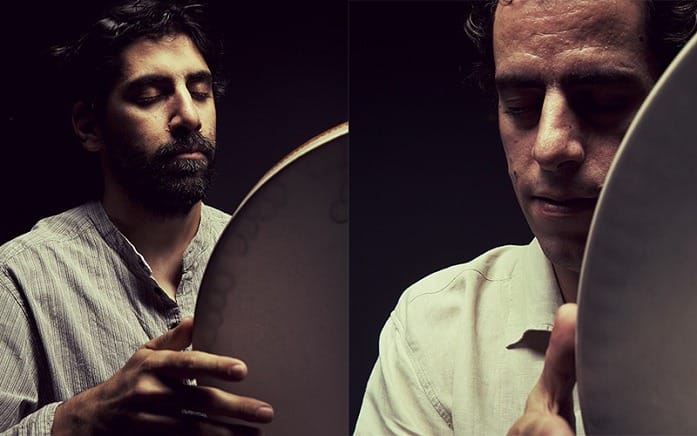
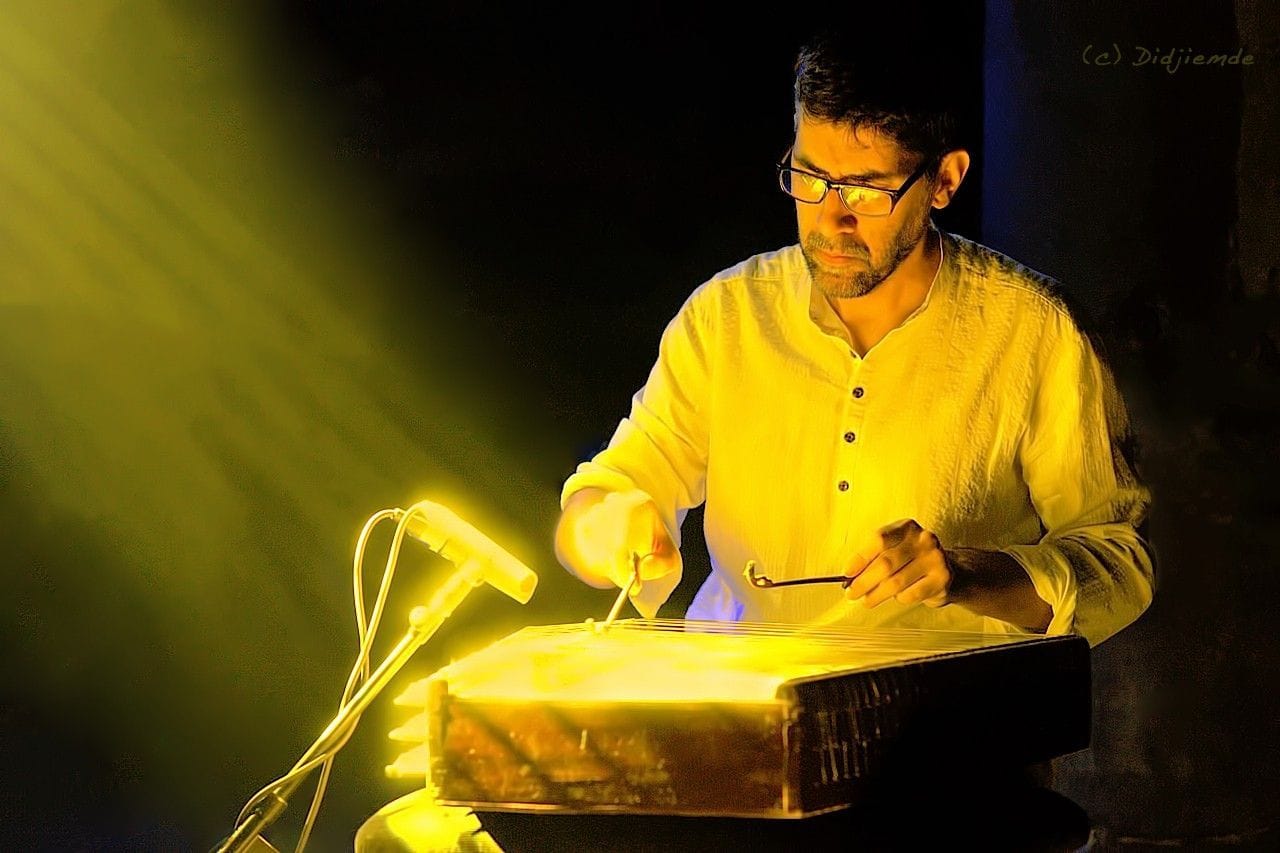
Conceived around percussionist and artistic director Keyvan Chemirani, this Nuit Bleue Orientale brings together a constellation of some of the most distinctive artists on the current scene, in a free-flowing dialogue between tradition, improvisation, and virtuosity. As the hours unfold, the spellbinding rhythms of Persian and Indian percussion will give way to the deep inflections of the voice and the timbres of the qanun, lyra, sarangi, cello, and flute, in a series of musical scenes that are at once intimate, festive, and contemplative.
Centered around Keyvan and Bijan Chemirani, this evening will feature major artists such as Vincent Segal, Christine Zayed, Dorsaf Hamdani, Dilshad Khan, Sokratis Sinopoulos, Prabhu Edouard, and several other guests, for a grand celebration of rhythm, voice, and the memory of traditions.
Conceived as a journey, the evening will alternate between major concerts and more relaxed moments, allowing the audience to move about, listen, linger, and return. To close the event, a screening of the film Hâl, a tribute to Djamshid Chemirani, will extend this immersive experience with a more intimate look at musical and family traditions.
To complement this experience, the Blue Note Café will offer a selection of teas and sweets inspired by various Eastern cultures throughout the night.
More than just a series of concerts, La Nuit Bleue Orientale is an experience to be savored: a rare, generous, and deeply soulful musical evening to be shared until the end of the night.
From Saturday, July 4, at 7:00 p.m. to Sunday, July 5, 2026, at 4:00 a.m.
For *The Rhythm Alchemy*, Keyvan Chemirani has assembled an extraordinary ensemble—generous and open to both world cultures and contemporary sounds—at the crossroads of East and West. Because, for him, music is above all a family affair, he has invited his brother Bijan Chemirani, as well as close friends and fellow artists. The Persian rhythms of the zarb, daf, and ud blend with Prabhu Edouard’s tablas, Pierre Alain Tocanier’s drums, Vincent Ségal’s cello, Sokratis Sinopoulos’s Cretan lyre, and Julien Stella’s clarinet. Together, they explore the immense richness of timbres, colors, and rhythms—from percussion to the human voice, from the Indian subcontinent to Western drums. They celebrate this “alchemy of rhythm” with pleasure, groove, and jubilation as their only watchwords. From mystical Persian poems of the 12th and 13th centuries, recited by Aida Nosrat, to Julien Stella’s incredible beatboxing, a unique language is invented here—one that is both unfamiliar and familiar.
Artists
Aïda Nosrat, text
by Keyvan Chemirani, zarb, percussion, santur; artistic
direction by Bijan Chemirani, zarb, daf, saz
; Prabhu Edouard, tablas, kanjira
; Pierre-Alain Tocanier, percussion
; Vincent Segal, cello
; Sokratis Sinopoulos, lyra
; Julien Stella, bass clarinet, beatbox
Christine Zayed’s musical project is a deeply personal exploration, rooted in Palestine and transformed into a universal language of connection. Through the expression of profound emotions and shared human experiences, it seeks to forge connections while honoring the authentic essence of inherited musical traditions. The project is primarily influenced by classical Arabic music, particularly the maqam (the art of Arabic modal improvisation), and contemporary Palestinian poetry. It also draws inspiration from a wide range of musical repertoires, fusing traditional Levantine songs with influences from cultures near and far.
At the heart of the project lies an in-depth exploration of the qanun, a versatile instrument that is at once melodic, harmonic, and percussive. Its rich and dynamic sound offers a striking contrast to the vocal techniques of Arabic music, making it the ideal companion for the project’s expressive depth. This project is further enriched by the contribution of Sylvain Barou, a captivating flutist whose unique sound blends Breton and Irish traditions with influences from Hindustani, Turkish, Armenian, and Iranian music. His mastery of instruments such as the bansuri, the duduk, and the zurna, as well as the wooden transverse flute, brings a rich diversity to the project.
Artists
Christine Zayed, vocals, qanun
Sylvain Barou, flute
Keyvan Chemirani, percussion
Khayal is the contemporary genre of North Indian classical music. It is a word of Arabic origin meaning “dream” or “imagination.” This style of classical music is the result of a spiritual and musical convergence that took place on the Indian subcontinent around the 16th century. A fusion of Sufism and Hinduism, carried by Persian music and dhrupad, the ancient and liturgical music of North India.
This captivating music is associated with Kathak dance, one of the seven classical dance styles of India. The defining feature of Kathak, as its name suggests, lies in storytelling: in fact, “katha” in Sanskrit means “story.” The Kathak style, said to be the historical source of
Flamenco, transforms its performer into a virtuoso dancer-storyteller in the service of the mythology of the Hindu pantheon. But no two stories, songs, or dances are ever exactly the same, for improvisation is a major characteristic of khayal, and imagination is its poetic catalyst. And as for dreams, in the land of a thousand gods, it is said that our world is but the manifestation of a dream of the great creator Brahmâ! A mystical and dreamlike moment where the intoxicating swirls of Raga melodies blend with a body twirling to the rhythm of Kathak and the virtuoso spirals of the tabla’s rhythmic cycles!
Artists
: Prabhu Edouard, tablas
: Sharmila Sharma, Kathak
dance: Indrani Mukherjee, Khayal
singing: Dilshad Khan, sarang
This concert offers an intimate journey into the heart of Iranian music, where the voice and the setar together chart an unpredictable course. Here, nothing is set in stone: the form emerges in the moment, nourished by listening, breath, and the subtle interplay between the vocal timbre and the resonance of the instrument. The nuances, tensions, and expressive depth of the Persian musical tradition are gradually revealed, making each performance a unique creation born in the moment.
Artists
Hamed Zoheiri, vocals and readings
11:00 PM – 12:00 AM | CONCERT 5: Tarabi
Tarab is the Arab musical art form in which the voice and melody transport the audience into a state of ecstasy and deep emotion. This performance celebrates three major schools of Arabic singing: those of Oum Kalthoum, Asmahan, and Fayrouz. This ambitious project takes on a special dimension with the performance of Tunisian singer Dorsaf Hamdani, whose voice combines power, finesse, and emotion, making her the ideal artist to revisit these legendary repertoires. In this journey, Dorsaf Hamdani explores these three distinct worlds, highlighting the nuances of Tarab. Oum Kalthoum, the quintessential ambassador of Tarab, the Star of the Orient, was an Egyptian singer who embodied vocal power and emotional interpretation taken to the extreme. Her songs, such as Al-Atlal, Enta Omri, and Roubaiyat Al-Khayyam, are masterpieces that blend improvisation, long melodic phrases, and intense lyricism. A performance imbued with the mastery of maqam and improvisation that define the richness of Tarab.
With her crystalline timbre and a technique reminiscent of European opera singing, Asmahan represents a fusion of East and West. Her songs, such as “Ahwa” or “Layali El Ouns fi Vienna,” showcase a more refined Tarab, where the voice dances over delicate and poetic melodies.
With Fayrouz, Tarab takes on a more spiritual and intimate form, where the melody melts into a nostalgic tenderness, a more meditative approach to Arabic poetry. Songs like “Baadak ala Bali” or “Kifak Inta” showcase a more refined yet still spellbinding approach. “Tarabi” will thus be a tribute to these great voices of the Arab world, reimagined by a minimalist ensemble—featuring the oud, buzuq, and Arabic-Ottoman percussion—and an exceptional artist, for an evening where music and emotion will reach their peak.
Artists
: Dorsaf Hamdani, vocals
; Pierre Clavé, guitar, oud, buzuq, and Arab-Ottoman
percussion; Bijan Chemirani, percussion
Coming together for an exceptional concert, Efrén López, Sylvain Barou, and Sokratis Sinopoulos weave a tapestry of musical traditions from the Mediterranean, the Balkans, and the East. A multi-instrumentalist of rare erudition, Efrén López unfolds a sound world of fascinating richness, drawing on ancient repertoires, modal music, and popular influences skillfully reinvented.
At his side, flutist Sylvain Barou brings a free and virtuosic touch, at the crossroads of Celtic, Eastern, and improvised aesthetics. Finally, Sokratis Sinopoulos’s Greek lyre, deep and spellbinding, lends this ensemble a singular voice that is at once intimate, archaic, and intensely contemporary.
Together, these three artists weave a musical landscape of great finesse, where tradition becomes a space for encounter, listening, and invention. A sensitive journey, between the memory of peoples and the freedom of the present.
Artists
: Efren Lopez, multi-instrumentalist
; Sylvain Barou, flute
; Socratis Sinopoulos, Greek lyre
A leading figure in contemporary Greek lyre music, Sokratis Sinopoulos has developed a musical world of great subtlety, drawing on both tradition and improvisation. His playing, both intense and refined, brings to life the full expressive richness of this ancient instrument. This mini-concert invites you to an intimate listening experience, blending meditative depth with free expression.
Artist
: Sokratis Sinopoulos, Greek lyre
This project explores the essential yet delicate role of vocal accompaniment—that sensitive space where the percussionist becomes a partner to breath, silence, and the spoken word.
Aïda Nosrat’s voice, rooted in Persian tradition yet open to Azeri and Kurdish repertoires, unfolds with a free, deeply felt expression. She weaves an intimate connection between languages, timbres, and emotions. In response, Chemirani’s percussion, accompanied by Milad Mohammadi’s târ, embraces and extends the rhythm of the poems, whether spoken or sung. The framework expands, forms transform, giving way to a fluid interplay between composition and improvisation.
From this encounter emerges vibrant music, where tradition and invention engage in a dialogue of constant listening, sketching a soundscape that is both intimate and in motion.
Artists
Aïda Nosrat, text and vocals
Milâd Mohammadi, tar
Bijan Chemirani, percussion
Keyvan Chemirani, percussion
Djamshid Chemirani and his two sons have formed a zarb trio—the zarb is an Iranian percussion instrument—that performs all over the world. For the first time, the father is taking his two sons to Iran. This film explores the sons’ perspective on Iran, as well as the father-son and teacher-student relationships that are the very essence of Persian music and which they will encounter during this journey.
Documentary
Directed by Yves de Peretti • Written by Yves de Peretti
Netherlands, France • 2003 • 54 minutes
Main credits
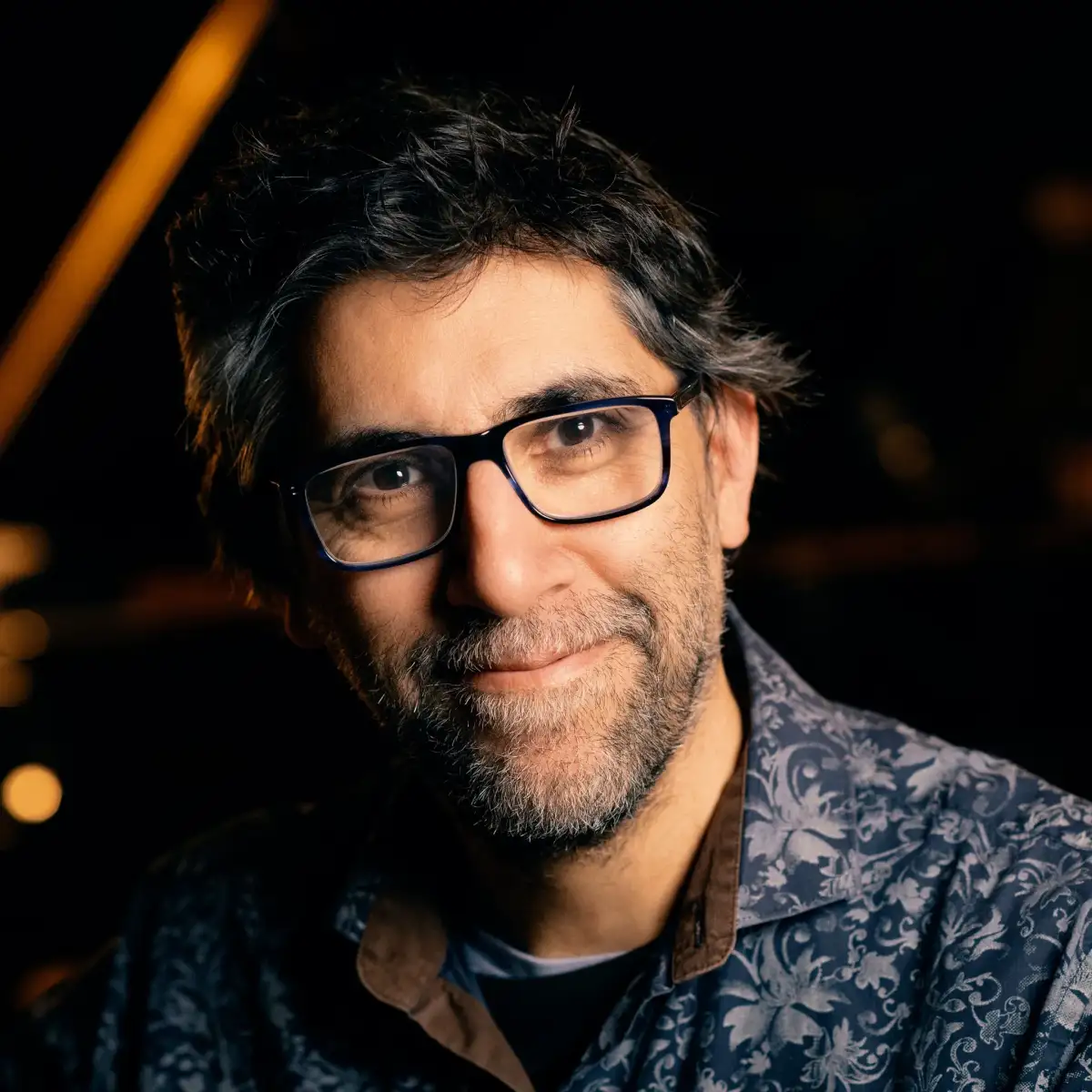 Keyvan ChemiraniPercussion